















How to score 120 in TOEFL within 12 days - a complete step-by-step guide!!




Are you speculating on how to start preparing for TOEFL?
Are you wondering what skills this test will assess?
What exactly is the strategy to score a perfect 120 in TOEFL?
If all these things are enveloping your thoughts, then this is what we are going to discuss here.
One of the most critical tests for an applicant planning to move abroad is TOEFL, which evaluates a candidate's English language proficiency. If you aspire to study or immigrate to an English-speaking country, English language proficiency scores are the must-haves.
The Test of English as a Foreign Language or TOEFL is amongst the widely-known proficiency exams accepted by foreign universities as well as numerous organizations, including the immigration department, to process residential, work, and study visas.
TOEFL gauges an aspirant's hold on the English language through an extensive assessment of their writing, speaking, listening, and reading competencies.
Through this blog, we will familiarize you with the several features of TOEFL, its pattern, syllabus, and preparation tips & strategies.
What is TOEFL?
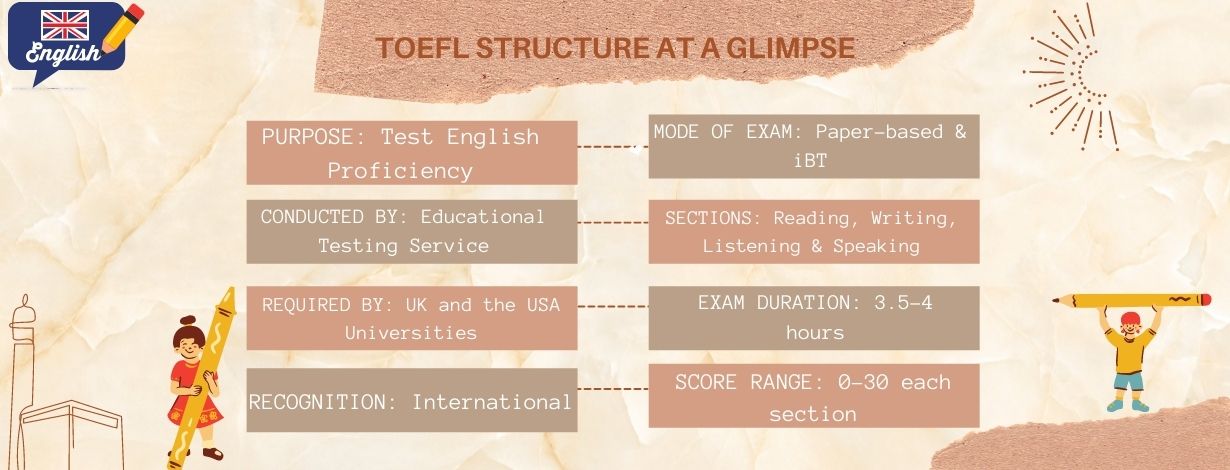
This language proficiency test, conducted by the Educational Testing Service (ETS) is widely accepted by over 10,000 universities and institutions in more than 130 countries, including the USA, New Zealand, Canada, the UK, Australia, and Europe. The exam is of two types, paper-based and internet-based, out of which the TOEFL-iBT is the most preferred one amongst the test takers.
Everything to know about TOEFL Score!
The TOEFL total score comprises the aggregate of the score of all the four sections: Reading, Writing, Listening, and Speaking. The scores are calculated on a scale of 0-120, where 120 is the maximum and 0 is the minimum. While each section has its own marking scheme of 0-30. Let's understand this with an example: Suppose if you score 27 in Reading, 25 in Speaking, 26 in Listening, and 20 in Writing, then your total score would be 98.
- Is it even possible to get 120 in TOEFL?
The answer to this question is YES. However, scoring the perfect 120 is extremely rare. Moreover, to score 120 in total, you would be required to achieve 30 in each section.
TOEFL pattern
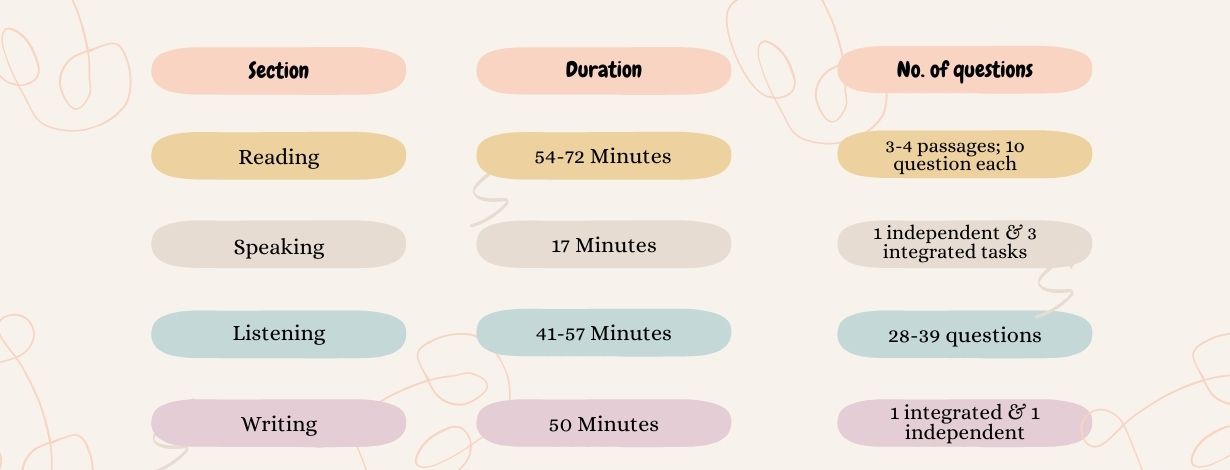
The computer-based test, commonly tagged as iBT exam generally lasts for 3-4 hours. The following chart expounds upon the exam pattern in detail:
How can I get 120 in TOEFL? How can I prepare for TOEFL in 15 days?
Here, in this blog, I will share the strategy with which you can score 120/120 with the preparation of just 10-14 days. Keeping the smart work and diligence constant, the tactics I am going to present will help you achieve the 'perfect looking TOEFL score.'
NOTE: Book your TOEFL test ahead of time because you might not get the desired date on booking at the last hour.
Before beginning, let us briefly look at what is there on a TOEFL test.
The TOEFL test is divided into four sections:
1. Reading
2. Writing
3. Speaking
4. Listening
As per ETS, the organization that conducts the TOEFL, it is an exam that "assesses your all four academic skills - reading, writing, listening, and speaking - the way they are utilized in the academic environment." You are asked questions combining these four communication skills, and based on your proficiency in each, you will get marks. A higher score implies that you are likely to comprehend the literature material and survive in an academic environment with considerable ease. However, the test would be pretty much straightforward if you attempted it with a planned strategy. This article will assist you in making your first attempt the last one.
Tired of searching authentic practice material? Don't worry! Let us help you out!
PREPARING FOR THE READING SECTION

The Reading section of the TOEFL is designed to gauge your comprehension of academic literature material and long texts. Additionally, it judges how the test taker deals with unaccustomed vocabulary, complex sentence structures, central theme, distinct narration styles, and unfamiliar content.
In general, this section comprises 3-4 comprehension passages, each around 700 words. Further, each text comes with 10 questions. The total time revolves around 54 to 72 minutes to solve all the questions in this section.
The passages are extracts from university-level workbooks covering a variety of diverse subjects. The whole information required to respond to the questions will be given in the passage, and there would be no requirement to have a prior understanding of the concepts.
The TOEFL also provides a glossary feature that defines the words which are not commonly used in day-to-day conversations.
Don't skim and scan
The TOEFL will surely not give you the ease to skim the passages and questions, ultimately giving you a half understanding of what has been discussed. Commonly, there are questions that will demand minor details that further test your language aptitude and comprehensive power.
The first and foremost task is to understand the question and familiarize yourself with the minor details mentioned in the passage. If you skim through the text and skip the unknown vocabulary or phrases, then certainly, many questions will be left unanswered.
Let us now learn the tips and tricks to ace the reading section!
1. Acquaint yourself with the question types
The Reading section comprises 10 different types of questions. However, some may appear more often, and others will be asked comparatively less. Usually, most of the questions carry one point, but often there will be questions that will carry two or even three.
Here, you will find a tabular representation of the types of questions, along with the examples and their frequency.
| Question Type |
Frequency |
Question Structure |
| 1. Factual Information | 4-8 |
"According to the paragraph 2, which of the following is false?" "The paragraph 5 states that ____ occurred because..." |
| 2. Vocabulary | 3-6 |
"In stating this ____, the author intends to convey.." "The word ____ in paragraph 3 is closest in meaning to..." |
| 3. Negative Fact Questions | 2-4 |
"Which of the following is NOT mentioned.." "The author mentions all of these statements except.." "According to paragraph 4, which of the following is NOT true?" |
| 4. Rhetorical purpose | 2-4 |
"Why did the author mention ___ in paragraph 2?" "The author does ___ in order to..." "What is the purpose of mentioning...." |
| 5. Inference | 2-4 |
"Which of the following can be inferred..." "Paragraph 2 implies that..." "The passage implies that..." |
| 6. Paraphrase/Sentence Simplification | 2-3 | "Which of the following sentences best expresses the essential information in the highlighted sentence in paragraph 7?" |
| 7. Summary Questions | 2-3 | "An introductory sentence for a brief summary of the passage is given below. Complete the summary by selecting the THREE answer choices that express the most important ideas in the passage." |
| 8. Insert Text | 2-3 | "Examine the five ___, and indicate at which ___ the following sentence would fit best?" |
| 9. Reference | 0-1 | "The word ____ in paragraph 3 refers to..." |
| 10. Table completion/Organization Questions | 0-1 |
"Complete the table below to summarize information about ____ in the passage." |
2. Keep a check on the timer!
54 Minutes to answer around 40 questions and read more than 2000 words!! This is definitely going to be a challenge.
However, the best strategy to tackle this is to start reading long academic texts with a timer onn! Check out the sample reading tests available online and attempt to complete them in the stipulated time.
3. Identify the keywords and focus on them

Highlighting the keywords help you find the answers comparatively quickly!
Moreover, if you highlight the main information that may include nouns, verbs, and descriptive statements, it will become easier for you to scan the answers.
Suggestion: If you want to improve your reading skills, I would recommend you to read at least three articles in a week and highlight the keywords. Possibly, you might be curious by now to ask what kind of strategy can be used? The best way is to circle the nouns, mark a square around the figures, data, or numbers, and underline the statements that provide you justification or description of the preceding sentences.
4. Amass TOEFL-specific Vocabulary
There are certain words and phrases that appear regularly in the TOEFL texts and are usually linked to academic life.
Don't worry if you do not understand certain words as no one can ever learn the entire vocabulary. In this case, you should attempt to read the entire sentence and then try to infer its meaning.
Moreover, it would be best if you spend time to learn the synonyms and antonyms. Let us read how we can learn them?
Suppose you are reading an article, and it comprises of common vocabulary that can be used in our day-to-day academic environment. Jot down that word on a sticky note and look out for its meaning in the thesaurus. Adding on to it, search for its synonyms and antonyms. In this way, you would be able to retain more words in your mind as instead of a single word; you are dealing with 4 - two synonyms and two antonyms. For example, the sentence says, "Critics say that the current voting system used in the nation is inefficient and often leads to inaccurate counting of votes."
Let us take the word inefficient from the previous statement; the synonyms for the same can be ineffective and ineffectual, while productive and effective are the antonyms.
Are you searching for universities waiving both GRE and TOEFL for 2022? Your wait is over! Go over our comprehensive guide and apply to your dream universities.
PREPARING FOR THE LISTENING SECTION

The Listening task is comparatively less time-consuming than the Reading section. However, you would be required to process the information by hearing every detail, topic, and tone.
The Listening Section is specifically designed to extensively assess how the candidate understands spoken English, thus measuring your ability to comprehend lectures and conversations in English. Also, it examines an individual's abilities to interlink different topics, draw conclusions, and judge the tone & mode of the speaker.
There exist two types of listening content - lectures and conversations, both based on an academic setup.
- 3-4 lectures with six questions per lecture, and the time duration usually lasts 3-5 minutes for each audio.
- 2-3 conversations with five questions per conversation and each audio clip with 3 minutes duration.
The TOEFL allows you to take notes on any audio clip throughout the test to assist you to answer the questions.
The audios will be the general lectures and conversations that you are most likely to hear as a student on campus. They might include a short discussion between a student and teacher, a talk by a professor, or some seminat talk. However, you will be presented with the pictures on the screen that will give you an idea of the number of speakers and the setting.
Additionally, the audios will be replayed for some questions, but in most cases it will be played only once.
The following are the types of questions asked in the Listening test:
- The standard multiple-choice questions with four options and only one correct answer.
- MCQ with more than four options and multiple correct answers
- Organization questions generally demand the candidate to organize the events as per their occurrence in the audio
- Matching questions.
Let's learn the strategies to crack the listening section!
1. Start listening Spoken English, and gradually increase the listening time!
The more you hear, the more you will ameliorate your listening skills, and the easier it will be for you to tackle the listening module. Broaden your horizons and move ahead from the songs to practice listening. Podcasts, News Stations, Talk Shows, and Movies are the best options to start practicing with.
Bonus Tip: Try listening to the audios with background noise, such as a news interview being conducted in the marketplace or a protest site, because the TOEFL audios deliberately include background noises.
Record lectures and presentations, and refer to them till the moment you do not understand the main idea or context clearly. Learn to discern various styles of organization :
-
Theory & Evidence
-
Cause & Effect
-
Procedures
-
Comparisons
2. Filter information
Once you have heard the audio, it can be demanding to systemize everything you have listened to by the time the questions appear. Since you can not revisit the question again after answering, you must choose the correct answer in the first attempt.
You need use of time-efficient methodologies to shortlist the questions that you can answer quickly from the ones that will require more time.
Identify digressions and distractions: Often, the speakers will purposely indulge in discussing the topics apart from the theme. This is to judge your capability to filter out unnecessary information and time management skills.
Focus on the structure: Keep track of the different parts of a conversation/lecture, such as introduction, body, and conclusion. Additionally, distinguish the beginning, middle, and end if it is a narration.
Pay attention to details, including facts, examples, and opinions.
3. Take Notes Quickly

The listening section relies upon your notes. Yes, because you can not remember every piece of the information discussed in the audio.
Each audio is several minutes long and contains a lot of minor but important information. If you are not accustomed to taking notes, you will undoubtedly forget some of the points and therefore miss a couple of questions in the exam.
Let me share an easy note-taking strategy!!
I. Make use of the bulletins - Writing up the additional information under bullets will help you distinguish several sub-points.
II. Use numbers - Take notes in chronological order. As the audio proceeds, move with it. For example, if the audio is about a laboratory procedure and it begins with "First of all.....", then you should write "1" and jot down the information.
III. Draw symbols - If the recording is about a process, then you can mark symbols like arrows to denote what happens next.
4. Get accustomed to different English accents
The best way to prepare yourself for the TOEFL listening module is to listen to the audios in varied accents.
The TOEFL Listening recording will include a minimum of one native-speaker English accent apart from the North American accents.
By now, you must be thinking, Why does TOEFL have different accents in the recordings? So to answer this, I would like to tell you that this is done to prepare you to deal with the variety of English accents you might encounter during your academic career. The accents will certainly stem from Australia, the U.K., or New Zealand.
To tackle this, I suggest you listen to new clips or radio stations from the countries as mentioned above and buckle up to outshine in your exam.
Stressed about TOEFL and can not focus on selecting the universities? Unburden yourself now! We can also shortlist universities before you appear for TOEFL with a tentative score exclusively for your profile so that you can seize the early application benefits.
PREPARING FOR THE SPEAKING SECTION

Planned to measure your proficiency to speak English proficiently in an academic setting, the TOEFL Speaking section assists the evaluators in ascertaining your fluency in the English language.
It constitutes four tasks that correspond to realistic scenarios you might confront not only in the classroom but also outside the academic setting. This section demands quick thinking, inventiveness, and responding to the situations accordingly.
This section intends to evaluate whether the candidate is comfortable with speaking and comprehending academic as well as real-life conversations. Eventually, it checks whether you can articulate your thoughts meticulously, participate in class discussions, and reply promptly.
Let us have a glimpse at the types of questions in the Speaking section:
- Question 1 is the independent speaking task, wherein the candidate draws their responses entirely based on their ingenious ideas, opinions, and experiences. Generally, it comprises preliminary questions, such as introducing themselves and judging their approach, speaking style, and other intangible conversational skills.
- The other three questions are categorized as the integrated speaking task because they are an amalgamation of two or more skills. For example, listening & speaking or listening, reading & speaking. However, the tasks usually come from an academic setup, such as a campus situation or an academic course.
The responses will usually be 45 or 60 seconds long with 15-30 seconds of preparation time before each response.
Having briefed about the structure of the speaking section, let us now move to the inside tricks to shine out in this section!
1. Acquaint yourself with the range of questions
Part 1: The first task will be a 45 seconds-long monologue for which you will have 15 seconds to prepare.
In this part, you are required to exhibit your competence in speaking clearly and logically about familiar themes. Your ideas should rather be based on your personal experiences, unlike the notions presented in the academic material presented to you.
For example: Describe an important gift you have, tell us why it is important.
In this task, the topic is the important gift that you have. Do not forget to include why (the reasons) it is significant for you, and cite examples of what you mean.
Part 2: In this task, the preparation time will be 30 seconds while you will be required to speak for 60 seconds.
If the task is an integrated one, comprising reading, listening, and speaking, then you would be required to read a 100-120 words passage on a campus-relevant topic. Afterward, you will listen to audio from a academic setting and an academic passage in the following task.
Post this 30 seconds preparation time, you will have 60 seconds to speak about the interlink between the listening passage and the reading. While you read and listen, do not forget to take notes on the main points so that you can speak about how these parts are interrelated.
2. Practice more!
Are you the one who just remains a spectator and watches the videos? If yes, then certainly it is time for you to buckle up and start practicing.
Watching videos would be of no help unless you take lessons from them and start practicing on your own.
Take out 10 minutes, search for a TOEFL speaking question, prepare it in a minute, and speak about it as long as you can. I know you must be thinking that when we ultimately have to speak for about 1 minute, what is the benefit of wasting our energy for more than that? Then, you should know that speaking at length would help you gain confidence, frame longer sentences, and overcome unnecessary pauses & stuttering.
3. Learn all-trade phrases
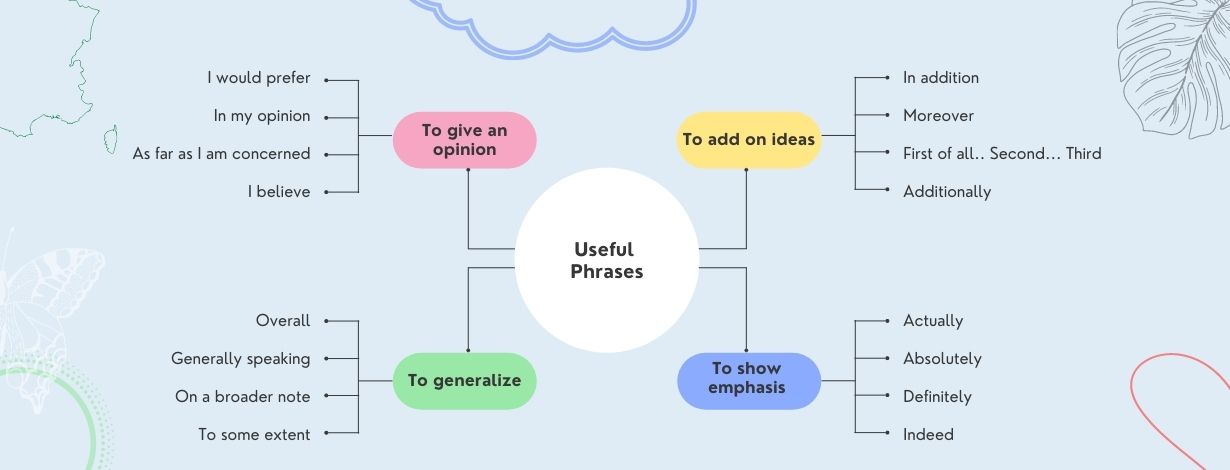
The time for both preparation and speaking will be limited therefore learning a few phrases that can be commonly used in almost every topic will help you enhance your fluency.
Here are a couple of phrases you can use during your speaking tasks:
4. Work upon pronunciation
Don't stress about your native accent; keep an eye on your pronunciation. Pay attention to the sounds that are missing in your first language, as you are more prone to mispronounce them.
Readout loud! Listen to native speakers! Mimic them! Yes, this is the easiest and the most efficient way to ameliorate your pronunciation.
Record your voice. Recording your voice is like rehearsing the script before the role play. Practicing clear and correct pronunciation is important as pronunciation is one of the criteria you will be evaluated upon.
One of the ways to practice speaking while acquainting yourself with the right pronunciation is Podcasts. Listen to a podcast, learn the pronunciation read out the transcript loudly. Further, record your voice and compare it with the podcast. This way, you will end up with perfect pronunciation.
You're definitely gonna rock if you pronounce specific sounds correctly and have good intonation. PS: The TOEFL is not going to judge your accent as every non-native has an accent predominated by their first language. So don't worry, you will not lose points for your accent.
PREPARING FOR THE WRITING SECTION
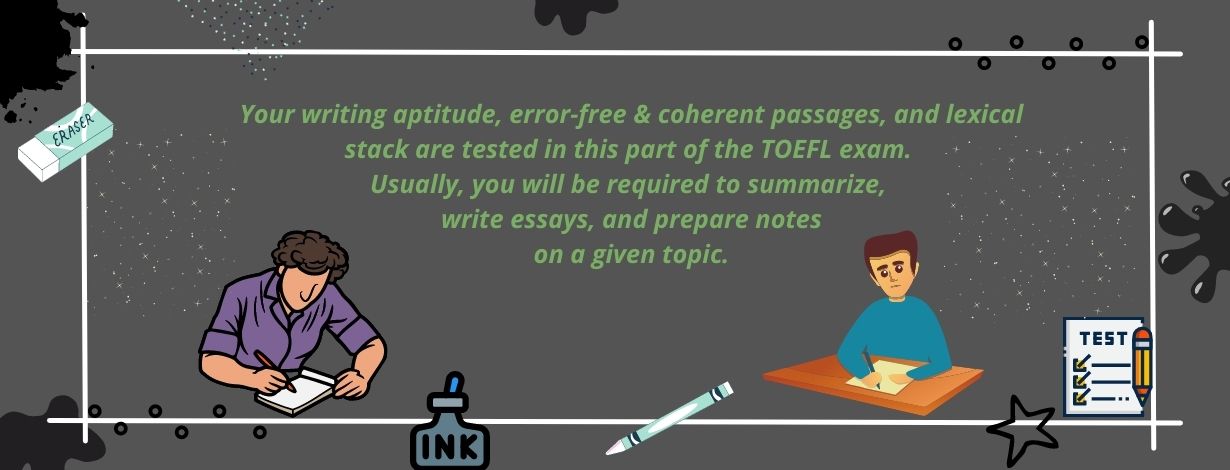
So, we have finally made to the last section! Let's have a look at the substructure of the Writing part.
Your writing aptitude, error-free & coherent passages, and lexical stack are tested in this part of the TOEFL. Usually, you will be required to summarize, write essays, and prepare notes on a given topic.
The following aspects are assessed in this part:
- Idea phrasing
- argument formation
- comparing conceptions
- usage of lexical resources
- cohesion & coherence building
- conclusion
- relating information.
There are two writing tasks - integrated writing and independent writing tasks.
While the integrated writing task lasts for 20 minutes and presents you with a short reading passage along with a short lecture recording, you will be required to write with reference to what you read and listened to. On the other hand, you have 30 minutes for the independent writing task, where you will have to write an essay based on personal experience or opinion, interlinking it to a writing topic.
Having discussed the strategies and tricks for the rest of the sections, let me give you the bird's eye view of tactics that will prove helpful in excelling in the writing test.
1. Embrace paraphrasing
Paraphrasing is extremely important in TOEFL writing. Your paraphrasing skills will give you an advantage during the integrated section of the exam. However, if you do not paraphrase the provided material and use the exact words from the passage or the audio, then you will lose scores for plagiarism.
Understand the main theme as well as the key ideas, move ahead with paraphrasing as it will assist in recalling those points from the sources.
By now, you would be thinking, How to paraphrase in my own words? Right? When we have read such extensive details about the TOEFL, then why not just spare two more minutes to learn to paraphrase! Let me help you out and share the strategy to quickly learn paraphrasing.
- In order to paraphrase, the premier requirement is to comprehend the original meaning and jot down proper notes.
- While reading the text or listening to the audio, do not copy the exact sentences. Rather, pen down the main idea or the keywords only.
- Take a look at your notes and assess if you can elaborate on these pointers & explain the similar idea to someone who is completely unaware of the context.
- Rephrase the central idea by using different sentence structures, substituting synonyms, and restructuring the word order.
Wouldn't an example work as a cherry on the cake? So, let's look at an example:
Base sentence - My undergraduate projects have provided me with crucial learning experiences.
Paraphrased version - The projects that I undertook during my bachelor's have imparted me with enriching experiences.
You can also look for paraphrasing exercises online to ameliorate your paraphrasing capabilities.
2. Plan ahead; elaborate later!

I know most of us will have the urge to start writing the moment we get the question. But that's a big NO! It would be best if you avoid this, no matter how much you have.
If you spend a few minutes planning your essay, it will help you remain focused on writing and not digress from the topic. On the contrary, if you do not plan make a rough plan and instantly start writing, then you will end up juggling between your infinite ideas.
You will have more time to review your essay as pre-planning helps you keep track of the ideas that you are going to share in the write-up and complete it comparatively early.
Spare 3-4 minutes to make an outline of your essay, which generally includes:
- A thesis statement, nothing but your point of view or stand.
- Main point 1, followed by sub-supporting points and examples.
- Main point 2, along with supporting points and examples.
- Conclusion
3. Learn generally used sentence structures
One thing that works on in every writing task is that you can use specific phrases or sentences to share your ideas or opinions.
Make use of cohesive devices. Grab a notebook, pen down a few cohesive devices or connectors, make notes on phrases that can be commonly used in any sort of essay.
For example: In order to enumerate, you can say
Firstly/First of all/Primarily.. etc. (To introduce the first idea)
Secondly/In addition to/Additionally.. etc. (To add on the second notion)
Finally/Moreover/After all.. etc. (To include the final pointer)
4. Keep an eye on your grammar & spellings

There are multiple ways to convey a single idea, ranging from changes in the sentence structure to modifying the tense. However, the majority of test-takers get stuck when it comes to accurately structuring your sentence.
Grammatical errors or spelling mistakes make it difficult for the reader to understand your essay.
If you have a doubt in the sentence structure or you are not comfortable in framing complex sentences, then it is better to focus on the quality and write shorter but precise sentences.
Are you bothered about tenses? Check out the grammar exercises available online or refer to your primary school grammar books. You just need to understand the basic sentence structure in different tenses. Do not forget to have a look at the verb forms of commonly used tenses so that you do not end up making faulty sentences.
However, even if you have four to five minor spelling mistakes, you can still score perfect points. YES! because the evaluator is kind enough;)
In sum and substance,
We made the best attempts to orient you to the strategies, tips, and tricks that are crucial to succeed in each section of the TOEFL. Endeavoring to help our readers, we have covered all the essential steps that you would require to ace the TOEFL in this article. We have discussed the tactics that are of immense help, according to us. However, everyone has their own ingenious approach, and no style is futile! The Team YMGrad wishes you all luck in nailing your TOEFL and scoring a perfect 120!
To watch the video on complete Day-by-Day TOEFL preparation plan, click here
Planning to attempt TOEFL but unsure how to start? Leave your worries to our experts with this premium TOEFL consultation and preparation plan.